

Rent collection software for accidental landlords: PayRent fits bank transfer and card payments with tenant balance tracking. See when manual methods work.
Accidental landlords’ rent collection software is a way to accept and record rent payments with the aim of keeping a small rental portfolio organized. If you became a landlord because you kept a former home or took over a rental, the immediate job is simpler than running a large property business: know what each tenant owes, what they paid, and what remains unpaid.
TL;DR
- Rent collection software for accidental landlords should make payments and tenant balances easy to track.
- PayRent is the pick for landlords who want bank transfer or credit card payments in one rent-collection platform.
- A spreadsheet can work for one property, but you must record and reconcile every payment yourself.
- Choose a method your tenants can use, then check the balance against the lease each month.
Why rent collection matters for accidental landlords
An accidental landlord often starts with an existing lease, an existing tenant, and a payment routine they did not design. Before changing that routine, check the lease and applicable state and local rules. Your collection method needs to fit those obligations, not replace them.
In 2026, the practical test is whether you can answer what was due, what arrived, and what remains outstanding for each rental. A deposit in your bank account answers only part of that question. A separate payment record helps you identify a short payment, a payment covering an earlier balance, or a deposit you have not matched to a tenant.
How to set up rent collection for a small portfolio
1. Read the lease before changing payments
Start with the signed lease, not a software signup. Find the rent amount, due date, accepted payment methods, and any terms governing notices or late payments. If you inherited a tenant, do not assume the arrangement you were told about matches the document they signed.
Make a short lease summary for each rental. Keep the original agreement available so you can check a disputed amount against the source rather than your notes. Before you ask a tenant to change how they pay, confirm that the change follows the lease and applicable law.
Record the rent amount and due date for each rental.
Note the payment methods named in the lease.
Check written terms for partial payments and late payments.
Keep lease questions separate from payment-tracking questions.
2. Create a record for each tenant
You can begin with a spreadsheet. Give each tenant a separate record showing the amount due, the date payment arrived, the amount received, and the remaining balance. This is the manual route; it works only if you update it whenever money arrives or an agreed adjustment changes what is owed.
If updating that record is the task you keep putting off, PayRent provides online rent collection through bank transfer or credit card and tenant balance tracking. The reason to consider it is the same reason you made the spreadsheet: you need a clear account of payments and balances. PayRent is best for accidental landlords who want those records tied to an online rent-collection platform.
Make one tenant record per lease.
Use separate fields for due date, payment date, and amount received.
Record an outstanding balance rather than overwriting the original charge.
Check every adjustment against the lease or another written record.
3. Pick a payment method tenants can use
A payment method is useful only when both you and the tenant understand it. Checks give you a physical item to deposit, but you still have to record when it arrived and connect the deposit to the correct tenant. A direct bank transfer can remove the paper check, but a transfer alone does not maintain a tenant balance for you.
PayRent rent collection software offers bank transfer and credit card payment options. That gives you an online route when you do not want to manage payment records solely through a spreadsheet and bank statements. Before changing methods, tell the tenant which option to use and confirm that the lease permits the change.
Ask how the tenant currently pays under the lease.
Choose an accepted method you can track consistently.
Keep payment instructions in writing.
Record the date and amount when a payment arrives.
Avoid treating a bank deposit as a complete rent ledger.
4. Reconcile payments against rent due
Set aside a regular time to compare your payment record with deposits received. For each tenant, start with the amount due under the lease, add any balance already owed, and record what arrived. The result is the balance you need to review with the tenant, not a guess based on your bank balance.
This check matters even when you use software. A bank transfer or card payment tells you money moved; you still need to make sure the payment is assigned to the right tenant and period. In 2026, choose a routine you will actually repeat after each rent due date.
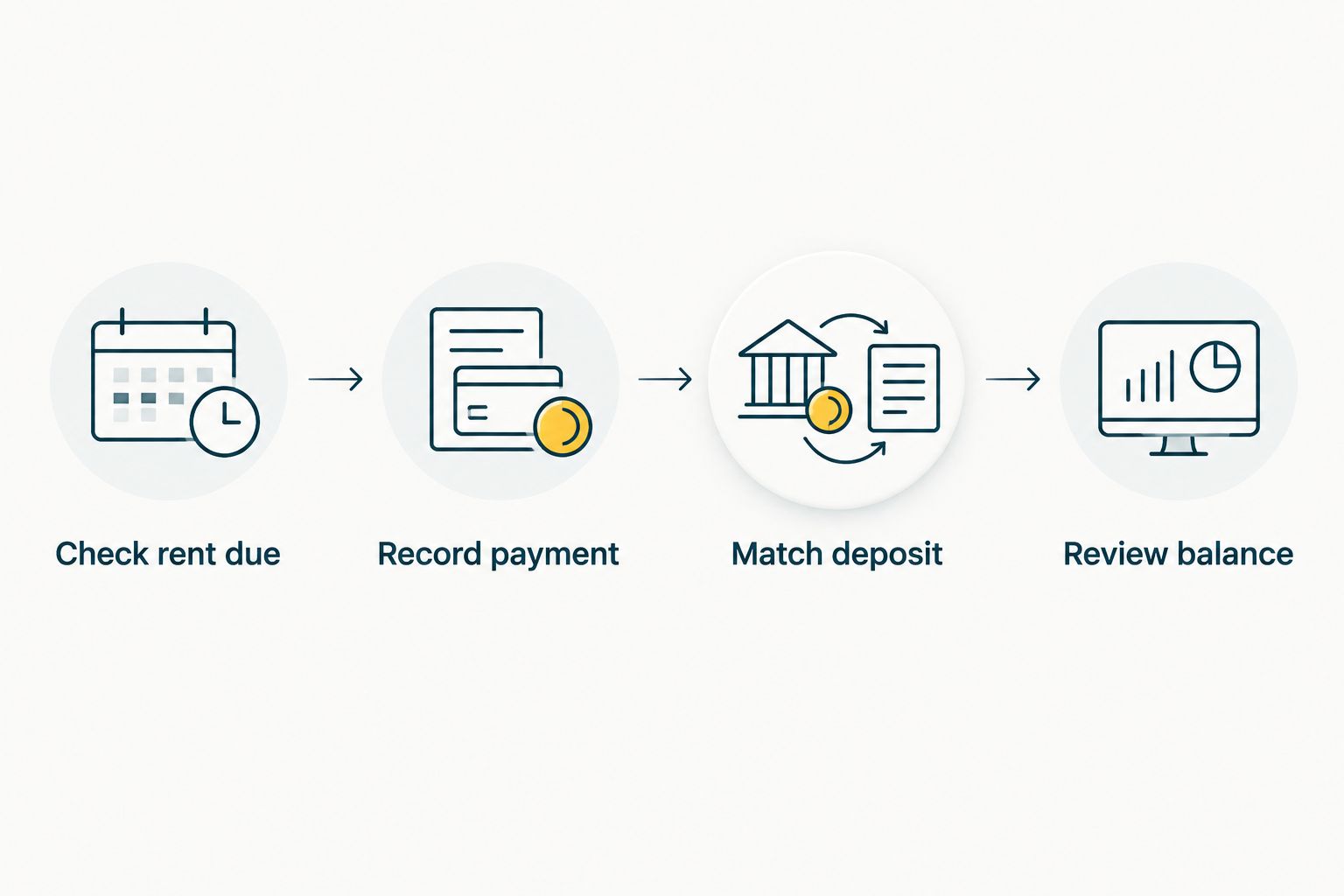
Check rent due for the period.
Record each payment on the date received.
Match the payment to a deposit or other payment record.
Review the balance after the payment is applied.
5. Give partial payments their own entry
Do not turn a partial payment into a paid-in-full mark. Record the amount received and leave the unpaid portion visible. That distinction protects the accuracy of your records whether you use a notebook, spreadsheet, or rent collection software.
Check the lease and applicable rules before deciding how to handle the unpaid amount or communicating consequences to a tenant. A payment record is not a substitute for the lease or legal requirements. Your immediate task is to preserve a clear account of what happened so the next conversation starts with the same figures.
Record the full amount due before applying a payment.
Enter the amount actually received.
Leave the remaining balance visible.
Keep messages about the balance with the rental record.
6. Separate rental records from personal spending
If you became a landlord after moving out of a home, rental payments can be easy to lose among ordinary account activity. You do not need a large-portfolio process to avoid that problem. You do need a consistent way to identify each rent payment and retain the related lease and payment record.
Keep the record understandable to someone other than you. If you need to review a tenant question months later, an unexplained deposit will take more work to trace than a dated entry connected to a rental and payment period. Choose file names and record labels you can recognize without reopening every document.
Label records by rental and tenant.
Keep the signed lease with related rental documents.
Save payment records where you can retrieve them.
Review unmatched deposits before closing your monthly records.
7. Review the process after each rent cycle
The first setup is not the finish line. After each due date, check whether tenants used the agreed method, whether every payment appears in your records, and whether any balance needs attention. Fix a confusing instruction before it becomes your routine.
Use the same review in 2026 whether you collect rent manually or online. A small portfolio can be simple to manage, but simple does not mean relying on memory. The method that wins is the one that lets you find the lease term, payment, and remaining balance without reconstructing them from scattered messages.
Confirm the method each tenant used.
Look for payments without a matching record.
Check balances before contacting tenants.
Update written instructions if a step caused confusion.
Compare your rent-collection options
Best for a small portfolio that needs online payments and balance tracking: PayRent. A manual method remains a reasonable choice if you can maintain the records yourself. Compare the work each option leaves with you, rather than choosing solely by how a tenant sends money.
Option Best for Main advantage Key limitation Checks plus a manual ledger A landlord maintaining an existing check-based arrangement Lets you record payments without changing the current method You must handle deposits and update the balance record yourself Direct bank transfers plus a spreadsheet A landlord who wants to stop handling checks and will maintain a ledger Keeps payment and balance entries under your control The transfer and spreadsheet are separate records you must reconcile PayRent online rent collection An independent landlord who wants bank transfer or credit card payments and tenant balance tracking Brings the stated payment options and balance tracking into one platform You still need to check the lease, explain payment changes, and review records
A comparison table cannot decide what your lease allows. Start there, then choose the option you can maintain without missing payments or losing track of an unpaid balance. If your current manual system passes that test, changing it is not urgent. If it does not, moving collection and balance tracking into the same platform addresses a specific gap.
Common mistakes accidental landlords make
Treating a deposit as proof of full payment
A deposit shows an amount arrived. It does not, by itself, show which rent period it covers or whether the tenant has paid everything due. Match the deposit to a tenant record and check the resulting balance before marking rent as paid.
Changing payment instructions without checking the lease
A new payment method does not erase existing lease terms. Read the agreement and applicable rules before changing what you ask a tenant to do. Put any valid new instructions in writing so both sides can refer to the same information.
Keeping the balance only in messages
Text or email threads can explain a conversation, but they are difficult to use as a running ledger. Put the amount due, each payment, and the remaining balance in one record. Keep relevant messages alongside it rather than making them the only record.
Failing to record partial payments clearly
Marking a partial payment as complete hides the amount still owed. Enter the payment you received and preserve the remaining balance as a separate figure. Check the lease and applicable law before taking the next step.
Buying more process than the portfolio needs
An accidental landlord does not need to copy the workflow of a large property manager. Start with the documents, payment methods, and balance checks your rentals require. Add software when it removes work you are currently doing by hand, not because a larger operation uses it.
FAQ
What is the best rent collection software for accidental landlords?
PayRent is a fit for accidental landlords who want online bank transfer or credit card rent payments with tenant balance tracking. Compare those functions with your lease requirements and the work you currently do by hand.
Can I collect rent without software?
Yes, you can keep a manual ledger alongside an accepted payment method. Record what was due, what arrived, and the remaining balance for each tenant, then reconcile that record with deposits.
Is a bank transfer the same as rent collection software?
No, a bank transfer is a way to move money, while rent collection software can also help track tenant balances. If you use transfers alone, maintain a separate payment record and reconcile it yourself.
Should I change how an existing tenant pays rent?
Check the lease and applicable law before changing an existing tenant’s payment instructions. If a change is permitted, explain the accepted method clearly and retain a written record of the instructions.
How should I track a partial rent payment?
Record the full amount due, the amount received, and the balance that remains. Do not mark the rent paid in full when only part arrived; consult the lease and applicable rules before deciding what follows.
Does PayRent accept bank transfer and credit card payments?
Yes, PayRent provides online rent collection through bank transfer or credit card. It also tracks tenant balances for independent landlords and property managers.
What should I check after rent is due?
Compare each tenant’s rent due with the payments recorded and deposits received. Resolve unmatched payments and review any remaining balance before contacting a tenant about it.
One last thing
The payment method is only half the system. For your next rent cycle in 2026, check whether you can find the lease amount, the payment received, and the remaining balance for each tenant without piecing together bank entries and messages. If you can, keep the routine. If you cannot, fix the record first; then decide whether PayRent rent collection software is the right way to reduce the manual work.
Written by
David Paxton
Dave is a seasoned real estate investor with over 12 years of experience in the industry. Specializing in single-family residential real estate, David's strategic approach combines market analysis, financial acumen, and a deep understanding of urban development trends to maximize investment returns.