

Is a text considered written notice? Not automatically. Check lease terms, state notice rules, delivery requirements, and proof before you act.
A text message can qualify as a written record, but it is not automatically a legally valid landlord notice to a tenant. For your 2026 rental decisions, the answer depends on the notice type, applicable state and local law, lease terms, and legally permitted delivery method. Do not rely on a text alone to start an eviction, termination, or other legal deadline unless the rules governing that notice expressly permit it.
TL;DR
- Is a text considered written notice? Sometimes, but written content and legally valid service are separate requirements.
- Check the notice type, rental location, lease terms, and delivery rules before relying on a text.
- A tenant’s reply helps document receipt; it does not automatically cure an improper service method.
- PayRent fits independent landlords who need online rent collection and tenant balance tracking, not a substitute for notice compliance.
Is a text message legally valid as landlord notice to a tenant?
A text is legally sufficient only when it satisfies the rules for that particular notice. The same message can document a conversation without meeting the requirements for formal service.
Online rent collection through PayRent addresses payments and balances. Whether a message legally serves notice is a separate question.
Before treating a text as formal notice, follow this sequence:
Identify the notice. A maintenance reminder is not a notice demanding payment or terminating a tenancy. Name the legal action you intend to take.
Find the governing rules. Check the state statute, applicable local ordinances, and any rules specific to the property or tenancy.
Review the lease. Look for notice addresses, delivery methods, electronic communication provisions, and consent requirements. A lease clause cannot override mandatory legal protections.
Check the content. Confirm the notice includes every required statement, deadline, recipient, and property detail.
Use an authorized method. Follow the required delivery procedure and preserve evidence of service. Send a courtesy text separately if useful.
The practical rule: permission to communicate by text is not necessarily permission to serve legal notices by text.
Why this matters
A notice does more than tell a tenant what you want. For some actions, it is a required step before you can proceed. Using the wrong delivery method can leave that prerequisite unsatisfied, even when the tenant understands the message.
For your 2026 notice procedure, separate routine communication from formal service. Keep conversations convenient, but make legal deadlines depend on the delivery method the governing rules recognize.
This article explains the decision process, not the rules for every jurisdiction. Get local legal advice before relying on a disputed notice or filing an eviction case.
Which messages need more than a text?
The purpose of your message determines what you must check. A request to confirm a repair appointment raises different issues from a demand that a tenant leave the property.
Communication Best for Practical advantage Legal limitation Routine text Scheduling and everyday questions Creates a dated conversation Does not automatically satisfy formal notice requirements Courtesy text accompanying formal notice Helping a tenant find an important document Adds another communication record Does not replace required service Notice delivered through an authorized method Actions with legally prescribed notice requirements Addresses the applicable service requirement Still requires correct content, timing, and recipients
Routine reminders and scheduling
Texting is useful for asking whether a tenant received a document, arranging a conversation, or discussing a maintenance request. Keep the wording clear about whether you are asking a question, confirming an arrangement, or delivering something legally significant.
An entry appointment still deserves a separate check. Permission to discuss repairs by text does not automatically establish that you have satisfied a statutory entry-notice requirement.
Rent demands and tenancy termination
Treat payment demands, termination notices, and notices supporting an eviction as formal legal documents. Check the specific statute rather than applying a general rule about electronic communication.
If a tenant is discussing an early departure, distinguish that conversation from a completed agreement or legally effective notice. The guide to options when a tenant wants to break a lease covers the separate decision about how to handle the tenancy.
Rent increases and lease changes
A proposed change, a tenant’s agreement, and a legally required notice are different things. Check whether the change is permitted, what advance notice applies, and how that notice must be delivered.
Do not assume that a reply agreeing to discuss a change amounts to acceptance. Preserve the actual agreement and any required notice separately from the surrounding conversation.
Why text-message notice validity varies
There is no single answer for every landlord notice. These factors determine whether your message does the legal job you need:
Property location. State statutes and local ordinances govern different aspects of rental notices. Start with the property’s jurisdiction, not your mailing address.
Notice purpose. Entry, nonpayment, termination, renewal changes, and other actions can have different requirements.
Delivery rules. A requirement for written notice does not, by itself, resolve whether texting is an authorized delivery method.
Electronic consent. Where electronic delivery is permitted, check whether a particular agreement, consent process, or designated address is required.
Required content. A properly delivered message can still fail if it omits information the law requires.
Timing and proof. The relevant rule determines when notice takes effect and how the notice period is calculated.
Keep these questions separate. A screenshot helps show content, but it does not establish that the chosen service method was legally authorized.
What electronic-signature law does—and does not—settle
The federal Electronic Signatures in Global and National Commerce Act generally prevents covered records from being denied legal effect solely because they are electronic. That principle is not blanket permission to text every landlord notice.
Federal electronic-record recognition does not replace state landlord-tenant service rules. The Act also contains specific exceptions involving certain notices concerning a person’s primary residence.
For a 2026 residential-notice review, consult the scope of 15 U.S.C. § 7003(b)(2)(B). It excludes specified notices involving default, eviction, and the right to cure under rental agreements for a primary residence from the Act’s general electronic-record rule.
That exception does not establish a universal ban on electronic landlord notices. It means you cannot rely on the federal Act alone to conclude that a text satisfies the applicable requirements. Check the state and local rules for the notice itself.
California examples: different notices, different rules
California illustrates why a general answer about written texts is insufficient. Its entry-notice and nonpayment-notice provisions address different purposes and procedures.
Entry notice: 24 hours is a statutory presumption
California Civil Code § 1954(d)(1) generally requires reasonable written notice for covered entries, subject to the statute’s exceptions. 24 hours is presumed reasonable notice in the absence of evidence to the contrary.
The provision identifies delivery methods and required notice details. The timing presumption alone does not establish that sending a text satisfies the delivery requirement.
Mailed entry notice: 6 days has a separate presumption
Under the same California provision, mailing an entry notice at least 6 days before the intended entry is presumed reasonable in the absence of evidence to the contrary.
That is a rule for the specified mailed-notice procedure, not a universal waiting period. Do not apply it to an eviction notice or assume it validates a text sent on the same schedule.
Nonpayment notice: 3 days requires different analysis
California Code of Civil Procedure § 1161(2) provides a 3-day notice framework for covered nonpayment cases, excluding Saturdays, Sundays, and judicial holidays from that period. Section 1162 addresses service methods.
For a 2026 California nonpayment notice, review those provisions together with applicable tenant protections and local requirements. The short notice period is not permission to choose an informal delivery method.
How to document a notice without mixing up the records
Build your notice file around what you need to prove: the document’s contents, the delivery procedure, and the applicable dates. Keep courtesy messages alongside that file rather than treating them as interchangeable with service evidence.
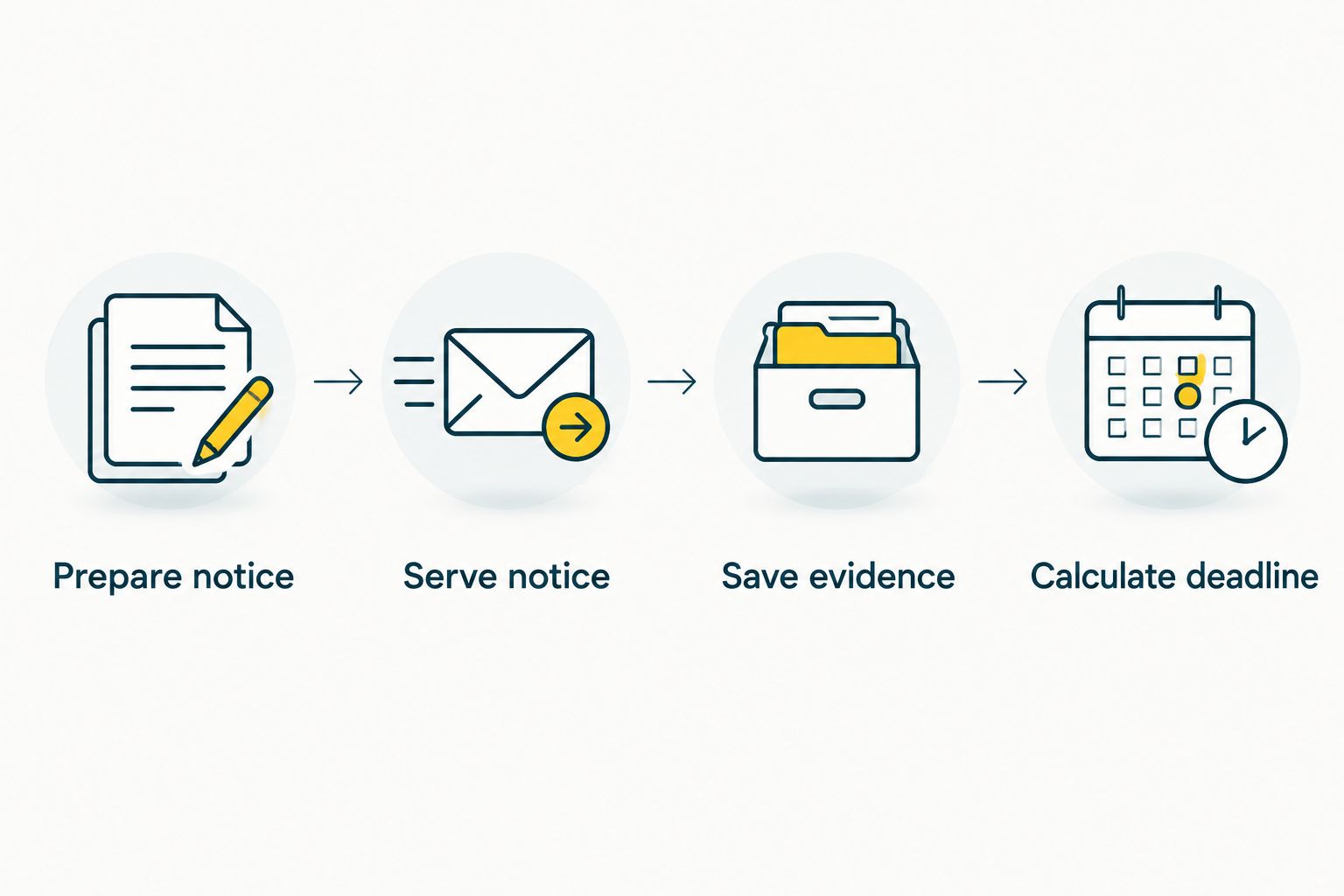
Use this sequence:
Prepare notice. Confirm the required content and review the applicable rule before delivery.
Serve notice. Use a legally authorized method and follow any required sequence or conditions.
Save evidence. Retain the exact notice, service record, relevant mailing records, and complete message thread.
Calculate deadline. Apply the governing counting rule and any delivery-related provisions before taking the next step.
Preserve the full conversation rather than a cropped excerpt. Include the contact information, timestamps, attachments, and surrounding replies that explain what happened. Keep the original records where possible.
If you discover a delivery problem, get advice before relying on the original deadline. Do not assume that forwarding the same text, receiving a reply, or sending a screenshot repairs the defect.
Where rent collection software fits
PayRent is best for independent landlords and property managers who need online rent collection and tenant balance tracking for small rental portfolios. The platform accepts rent through bank transfer or credit card.
That addresses payment administration, not the legal sufficiency of your notices. Keep the tenant’s balance, payment communications, and formal notice records organized, but assess service under the applicable law rather than the software used to discuss rent.
Does a tenant’s reply make a text legally valid?
A tenant’s reply is evidence that the tenant engaged with the message; it is not automatic proof of valid statutory service. The legal effect depends on the governing rule and the circumstances.
Save the reply, but do not treat acknowledgment as a substitute for a required delivery procedure. Receipt and legally sufficient service are separate questions.
Can my lease say that texts count as written notice?
A lease can address electronic communication, but a clause does not override mandatory notice law. Whether it authorizes a particular notice depends on the applicable statute, the clause, and any consent requirements.
Check the clause against each notice category you intend to use. A broad communication provision is not a reliable substitute for that review.
Should I send a text after serving a formal notice?
A courtesy text can help a tenant locate a notice, provided it accurately describes the document and does not conflict with it. Keep the required service procedure and courtesy communication distinct.
Avoid paraphrasing deadlines or adding new demands in the text. Inconsistent messages make the record harder to interpret.
FAQ
Is a text considered written notice from a landlord?
A text can be a written record without qualifying as legally valid landlord notice. Check the notice-specific content, consent, delivery, and timing requirements for the rental’s jurisdiction.
Can I text a tenant an eviction notice?
Do not rely on a text alone unless the governing rules expressly permit that service method for the required notice. A text about eviction does not replace any required court process.
Does a read receipt prove that a notice was legally served?
A read receipt does not by itself prove legally valid service. It does not establish that the delivery method, document content, or notice period satisfied the governing rule.
Is email better than texting for landlord notices?
Email is not automatically more legally valid than texting. Check which electronic methods, if any, the applicable notice rule permits and what consent or documentation it requires.
Can a tenant agree to get every notice by text?
A tenant’s agreement does not override mandatory legal requirements. Determine whether the applicable law permits electronic delivery for each notice category and requires a particular consent process.
What should I save when I send a landlord notice?
Save the exact notice, evidence of the authorized delivery procedure, and relevant dates. Preserve the full text conversation separately, including replies and attachments.
Does PayRent replace formal landlord notice requirements?
PayRent provides online rent collection and tenant balance tracking, not a replacement for legally required notice procedures. Check the applicable service rules independently of your payment records.
One last thing
A stronger screenshot cannot fix an unauthorized delivery method. Before your next formal notice in 2026, write down the notice type, controlling rule, permitted service method, and deadline calculation. Resolve those points before sending the message—not after a dispute starts.
Related guides
Written by
David Paxton
Dave is a seasoned real estate investor with over 12 years of experience in the industry. Specializing in single-family residential real estate, David's strategic approach combines market analysis, financial acumen, and a deep understanding of urban development trends to maximize investment returns.