
Compare ACH vs credit card rent payments for landlords. Use ACH as your default, understand payment risks, and offer cards with clear tenant rules.
ACH is the better default for collecting rent in 2026; credit cards work best as an optional payment method. ACH generally carries lower processing costs, while credit cards give tenants another way to pay but introduce card-processing charges and potential interest on unpaid balances. Neither method makes a submitted payment final, so your collection process must account for returns, disputes, and the difference between payment submission and cleared funds.
TL;DR
- ACH vs credit card rent payments: choose ACH for routine collection and credit cards for optional tenant flexibility.
- ACH payments can return; credit card payments can face chargebacks. A submitted payment is not final funds.
- Payrent supports rent collection by bank transfer or credit card and tracks tenant balances.
- Set written rules for payment deadlines, processing charges, failed payments, and partial payments before accepting online rent.
Why this matters
Your payment method affects more than how tenants send money. It changes your processing expenses, the records you need, and how you respond when a payment fails after submission.
Payrent is best for independent landlords and property managers who need online rent collection by bank transfer or credit card. Payrent also tracks tenant balances for small rental portfolios. Those functions support recordkeeping, but you still need a written payment policy and a process for reconciling transactions.
For your 2026 rent-collection policy, separate convenience from certainty. A tenant completing checkout does not mean the money has reached your bank account or that a later return or dispute is impossible.
Is ACH or credit card better for collecting rent?
Choose ACH for recurring rent collection when controlling processing expenses is your priority. Offer credit cards when providing another payment option justifies the additional processing expense and dispute procedures.
Both methods support online payment. The important differences are where the money comes from, how transactions fail, and what each method requires from your records.
Decision point ACH bank transfer Credit card Best for Routine rent payments from a bank account Tenants who want to use an available credit line Funding source Tenant's bank account Tenant's credit card account Processing expense Generally lower than credit card processing Generally higher than ACH processing Main advantage Practical default for recurring collection Additional payment flexibility Main drawback Insufficient funds and other returns can reverse a payment Processing charges, chargebacks, and potential tenant interest Payment certainty Submission does not guarantee successful collection Authorization does not eliminate later disputes Records to retain Authorization, payment history, and return information Payment history, rental agreement, and dispute evidence
Neither column replaces your lease or applicable law. Confirm how your provider labels payment stages, handles reversals, and records adjustments before you decide what counts as paid in your ledger.
ACH: Best for routine rent collection
ACH moves money between bank accounts through the Automated Clearing House network. For landlords, its strongest advantage is generally lower processing expense than accepting credit cards, particularly when collecting recurring rent.
The trade-off is payment uncertainty during processing. A tenant can submit a payment that later returns because of insufficient funds, incorrect account information, a closed account, or an authorization problem.
Use ACH as your standard payment option, but do not treat initiation as confirmation of cleared funds. Keep the transaction status visible in your collection records and investigate returns rather than simply sending another payment request.
What ACH does well
Routine collection: Rent comes from the tenant's bank account rather than a credit line.
Expense control: Processing generally costs less than credit card acceptance.
Recurring instructions: Where your provider supports recurring payments, tenants can authorize payments without manually submitting each installment.
What ACH does not solve
ACH does not guarantee that a tenant has enough money to cover rent. Recurring instructions do not remove the need to monitor failed transactions, and an account debit still needs valid authorization.
Before enabling recurring withdrawals, explain how tenants authorize them and how they change or cancel those instructions. Check your provider's procedures rather than assuming every bank-transfer service works the same way.
Credit cards: Best for optional payment flexibility
Credit cards let tenants fund rent from a card account instead of directly from a bank balance. That creates another payment route, but it does not reduce the rent obligation or erase the tenant's borrowing costs.
For landlords, the central trade-offs are processing expense and disputes. A card authorization is not a guarantee against a later chargeback, and responding to a dispute requires documentation.
Offer credit cards as a clearly explained choice, not as a substitute for assessing whether rent is affordable. A tenant who carries a balance can owe interest under the card agreement, even after the rent payment reaches you.
What credit cards do well
Payment choice: Tenants can use a card rather than fund the payment directly from their bank account.
Account separation: Rent can appear on a tenant's card statement, alongside the payment record from the collection service.
Backup access: A card provides another route when a tenant chooses not to use bank transfer.
What credit cards do not solve
Available credit is not the same as income. Accepting a card does not establish that the tenant can sustain future rent payments or repay the card balance.
Do not promise rewards, an interest-free period, or a credit-score benefit. Those outcomes depend on the tenant's card terms, account activity, and other factors outside your rent-collection process.
Why the better payment method varies
The ACH-versus-card decision depends on your collection process, not just tenant preference. Review these factors when setting your 2026 policy:
Processing expense: Compare the provider's current terms for each method, including how failed payments and disputes are handled. Identify who bears each charge before offering the option.
Tenant funding: ACH draws from a bank account; credit cards draw on available credit. Ask which payment routes your tenants can actually use without assuming a preference.
Payment status: Learn the difference between submitted, processing, successful, returned, and disputed transactions in your provider's system.
Authorization and records: Keep the tenant's authorization where required, the lease, transaction records, and relevant communications. Each serves a different purpose when a payment is challenged.
Lease and legal requirements: Payment-method requirements, added charges, and partial-payment treatment need to match your agreement and applicable law. Card-network and provider rules also affect card acceptance.
The right default should reduce routine administration without concealing exceptions. If you cannot explain what happens after a failed payment, the policy is unfinished regardless of which payment method you choose.
How should you set up ACH and credit card rent payments?
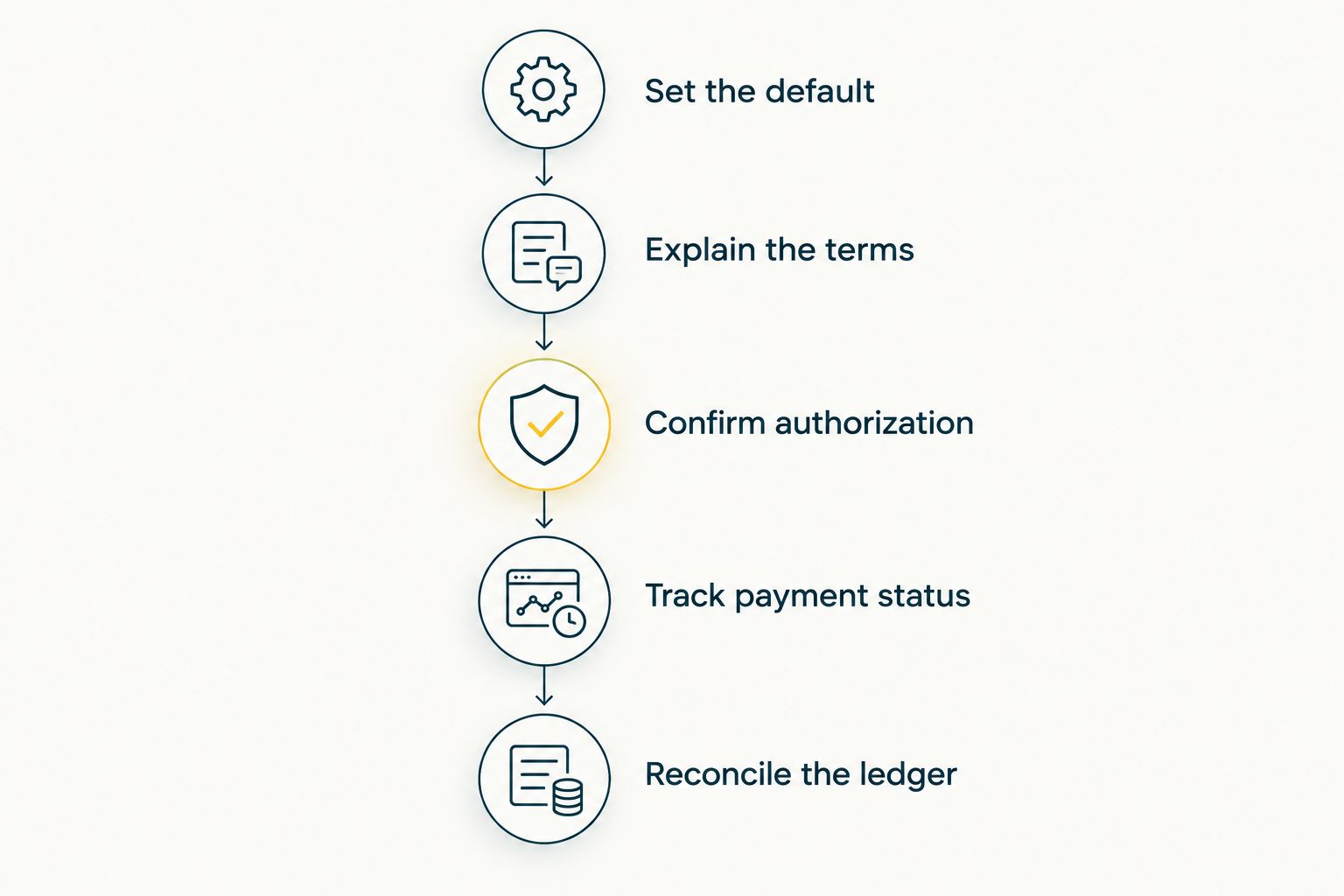
Use this workflow when reviewing your rent-collection process in 2026. The goal is a consistent record from the tenant's initial payment instruction through any later adjustment.
Set the default. Make ACH your standard route when processing expense is the deciding factor. State whether credit cards are also accepted, and check any requirements governing alternative payment methods.
Explain the terms. Tell tenants how to submit payment, where to see transaction status, and how processing charges are disclosed. Match the instructions to your lease and provider's actual process.
Confirm authorization. Follow the provider's authorization requirements for the chosen payment method. Do not assume that permission for a single payment also covers recurring withdrawals.
Track payment status. Distinguish a submitted transaction from successful collection. Record returns, disputes, and refunds so the tenant balance reflects what actually happened.
Reconcile the ledger. Match the rent obligation, transaction history, adjustments, and bank deposits. Investigate differences before sending a balance notice.
A useful process gives you an answer to a simple question: what evidence supports the balance shown? Payment confirmations, bank deposits, and ledger entries describe different parts of the transaction; retain the records needed to connect them.
Payrent supports bank-transfer and credit-card rent collection with tenant-balance tracking. Use those functions alongside your written policy; software records do not replace the lease, payment authorization, or your responsibility to review exceptions.
What should your tenant instructions say?
Keep the instructions short enough to use during an actual payment problem. Identify the accepted payment methods, the contractual due date, how tenants report an error, and where they can check payment status.
Explain any recurring-payment arrangement separately from the underlying rent obligation. A tenant needs to understand both when rent is due and what an automatic payment instruction does.
Avoid a blanket statement that every processing delay makes rent late. Treatment of submission dates, received payments, late charges, and failed transactions must follow the lease and applicable law.
What should you do when a payment fails?
First, identify the transaction's actual status and failure reason. An ACH return, card decline, and card dispute are different events and require different responses.
Then update the ledger accurately and contact the tenant through your normal documented channel. Do not request a replacement payment until you have checked whether another transaction is still processing, because overlapping payments create avoidable reconciliation problems.
If the issue involves partial payment, a disputed balance, or an eviction proceeding, check the legal consequences before accepting or rejecting additional funds. Payment acceptance can affect a landlord's position under applicable state law.
Is ACH safer than paying rent with a credit card?
Neither ACH nor credit cards eliminate payment risk. ACH transactions can be returned or challenged, while card transactions can be disputed through the card system.
For landlords, safety means more than choosing a payment rail. Use the provider's approved payment process, protect account access, retain authorization records, and avoid collecting sensitive payment details through ordinary email or text messages.
For tenants, the relevant questions include who processes the payment, what information the landlord sees, and how errors are reported. Check the provider's actual practices rather than assuming every online rent service handles information identically.
Should you accept both ACH and credit cards for rent?
Accept both when tenant choice is useful and you can administer each method's rules. ACH remains the practical default for routine collection; credit cards provide an optional alternative.
Offering both also means explaining both. Your instructions should identify the payment method selected, any disclosed processing charges, and the process for resolving an unsuccessful or disputed transaction.
If administering card payments adds work you cannot manage consistently, review the payment setup before expanding it. More payment options do not fix unclear balances or incomplete records.
FAQ
What's better for landlords, ACH or credit card rent payments?
ACH is the better default when lower processing expense is your priority. Credit cards work best as an optional payment method for tenants who want to use a card account.
Can an ACH rent payment fail after the tenant submits it?
Yes, an ACH rent payment can return after submission. Insufficient funds, incorrect account information, closed accounts, and authorization issues are reasons a submitted transaction does not guarantee collection.
Can a tenant dispute rent paid by credit card?
Yes, a tenant can dispute a credit card rent transaction. Keep the rental agreement, transaction records, and relevant communications so you can respond through the processor's dispute process.
Does paying rent by credit card mean the landlord lends the tenant money?
No, a credit card rent payment uses the tenant's card account rather than a loan from the landlord. The tenant remains responsible for obligations under the lease and the card agreement.
Should landlords require automatic ACH rent payments?
Do not require automatic ACH payments without checking applicable law and your lease. Recurring debits also need appropriate authorization and a clear process for changing or cancelling instructions.
Can landlords pass credit card processing charges to tenants?
Passing credit card processing charges to tenants depends on applicable law, card-network rules, provider terms, and the rental agreement. Confirm those requirements and disclose permitted charges before payment.
Does Payrent accept bank transfers and credit cards for rent?
Payrent supports online rent collection by bank transfer or credit card for independent landlords and property managers. It also tracks tenant balances for small rental portfolios.
One last thing
A clean payment history is not the same as a correct rent balance. A transaction list shows payment activity; a rent ledger must also account for the obligation, credits, reversals, and other valid adjustments.
Before changing your payment policy in 2026, reconcile the opening tenant balance. Otherwise, a better payment method simply carries an old accounting error into the next collection cycle.
Related guides
Written by
David Paxton
Dave is a seasoned real estate investor with over 12 years of experience in the industry. Specializing in single-family residential real estate, David's strategic approach combines market analysis, financial acumen, and a deep understanding of urban development trends to maximize investment returns.