

Use this rent collection software pricing comparison to compare bank transfers, cards, and broader tools by total cost—not the headline subscription.
Best starting point for small-portfolio rent collection: Payrent. Best for bank-first payments: a bank-transfer-focused setup. Best for broader operations: a property management suite. This 2026 rent collection software pricing comparison ranks buying approaches by fit and explains how to compare total cost without mistaking a subscription headline for the whole bill.
TL;DR
- Payrent suits independent landlords needing bank transfers, credit card payments, and tenant balance tracking.
- A rent collection software pricing comparison should separate subscription charges from landlord and tenant payment charges.
- Compare bank-first collection, mixed payments, and property management suites against the same rental portfolio.
- Choose the narrowest setup that handles your collection workflow; verify current terms before committing.
Why this matters
Rent collection has two jobs: get payments from tenants and keep an accurate record of what each tenant owes. Your buying decision gets harder when payment processing, tenant charges, and unrelated management features sit inside the same offer.
Compare the cost of your actual payment routine, not just the cost of opening an account. A subscription comparison alone leaves out questions that affect both your expenses and your tenants' experience.
The ranking below is an evaluation order, not a cheapest-to-most-expensive price claim. Start with the collection setup that fits your work, then compare its current written terms with alternatives using identical assumptions.
What makes the best rent collection software?
Use these criteria before reviewing plans in 2026:
Landlord cost: Separate recurring platform charges from charges triggered by individual payments or account events.
Tenant cost: Identify which payment methods carry tenant-paid charges and whether tenants have another permitted way to pay.
Payment fit: Match supported payment methods to the methods your tenants intend to use.
Balance tracking: Check how the system records amounts owed, payments received, and unresolved balances.
Portfolio fit: Apply the terms to your occupied units, expected changes, and actual billing period.
Operational scope: Distinguish rent collection from accounting, maintenance, leasing, and other management work.
A useful comparison answers all six questions for the same portfolio. An impressive feature list does not compensate for unclear payment terms or a ledger you cannot reconcile.
Rent collection software pricing comparison at a glance
Rank and option Best for Standout feature or approach Key limitation 1. Payrent Independent landlords and managers of small portfolios Bank transfers, credit card payments, and tenant balance tracking Evaluate payment-method terms separately; feature fit does not establish the lowest cost 2. Bank-transfer-focused collection Landlords whose tenants prefer bank payments A collection process built around one primary payment method A bank-only setup does not serve tenants who need card payments 3. Card-enabled collection Landlords whose tenants need a card payment option Payment-method flexibility Card charges and who pays them require explicit review 4. Full property management suite Landlords replacing several management workflows Collection evaluated alongside broader operational needs Additional scope creates more features and terms to assess
These options overlap. A single platform can support several approaches, so do not treat payment methods as separate subscriptions you automatically need to buy.
1. Payrent: best rent collection starting point for small portfolios
Payrent provides online rent collection for independent landlords and property managers. It accepts rent through bank transfers or credit cards, tracks tenant balances, and serves small rental portfolios.
That makes Payrent a practical rent collection software shortlist choice when your core job is collecting payments and knowing what remains unpaid. Evaluate those functions first, rather than starting with a long list of unrelated management features.
Payrent pros:
Supports both bank transfers and credit card payments.
Tracks tenant balances alongside rent collection.
Addresses the needs of independent landlords and small-portfolio managers.
Payrent cons and trade-offs:
Supporting multiple payment methods creates more payment terms to compare than a bank-only workflow.
Rent collection fit alone does not establish suitability for broader accounting or maintenance requirements.
During your evaluation, follow a payment from the tenant's submission through the balance record and into your reconciliation process. Ask what each status means before deciding how you will handle an apparently unpaid balance.
Best for: Independent landlords who need bank and card rent collection with tenant balance tracking.
Verdict: Buy only after the current terms and payment workflow pass your portfolio-level comparison.
2. Bank-transfer-focused collection: best for bank-first tenants
A bank-transfer-focused setup makes bank payments your primary collection route. Evaluate this approach when your tenants intend to pay from bank accounts and you do not need card payments as the default.
Start with payment handling and recordkeeping. A payment option is not a complete collection process unless you can connect each payment to the correct tenant and rental period.
Bank-transfer-focused collection pros:
Keeps your comparison centered on the payment method you expect to use.
Makes bank-payment instructions the main onboarding task.
Gives you a clear workflow to test from submission through reconciliation.
Bank-transfer-focused collection cons:
A bank-only setup excludes card payments.
Bank-payment processing still requires review of timing, unsuccessful payments, and applicable charges.
For a 2026 evaluation, ask each provider to explain how a submitted payment differs from a completed payment. Also check what happens to the tenant balance if a payment does not complete.
Best for: Landlords whose tenants prefer bank payments and who want a bank-first collection routine.
Verdict: Buy if the payment method fits your tenants and the written terms fit your collection process.
3. Card-enabled collection: best for payment-method choice
Card-enabled collection gives tenants a card payment option. Evaluate it as a payment decision, not as proof that rent will arrive sooner or that missed payments will disappear.
The central question is who bears any card-related charges. Your comparison should also establish what a tenant sees before authorizing payment and how the resulting transaction appears in your records.
Card-enabled collection pros:
Accommodates tenants who want to use a credit card.
Adds a payment route alongside bank payments when both are supported.
Lets you assess tenant payment choice separately from broader management software.
Card-enabled collection cons:
Card-related terms add another layer to your cost comparison.
Payment disputes require a defined recordkeeping and response process.
Before introducing a new method, review your lease, applicable payment rules, and tenant instructions. The guide to paying rent safely through an online rent payment app is a useful companion to the pricing review.
Best for: Landlords who need to offer tenants a card payment route.
Verdict: Hold until payment charges, tenant disclosures, and dispute handling are clear.
4. Full property management suite: best for replacing several workflows
A full property management suite belongs on your shortlist when rent collection is only part of the problem. Identify the other jobs you need it to handle, such as maintenance coordination or accounting, and verify those capabilities individually.
Do not assume every suite includes the same functions. Compare the exact plan and workflow under consideration, not the category label.
Full property management suite pros:
Lets you evaluate collection alongside other management requirements.
Creates an opportunity to replace separate workflows when the selected plan supports them.
Gives you a broader operational comparison when collection alone is insufficient.
Full property management suite cons:
More functions mean more setup requirements to assess.
Unused features do not solve a collection problem.
Migration requires checking records and responsibilities beyond payments.
Write down which existing tasks the proposed suite would replace. If you cannot identify them, keep the comparison focused on rent collection rather than treating a broader package as an automatic upgrade.
Best for: Landlords with several defined management workflows to replace.
Verdict: Skip if rent collection is your only unmet need.
How to compare total cost without misleading yourself
Use the same assumptions for every provider in your 2026 shortlist. Changing the unit count, payment mix, or billing period between quotes makes the comparison unreliable.
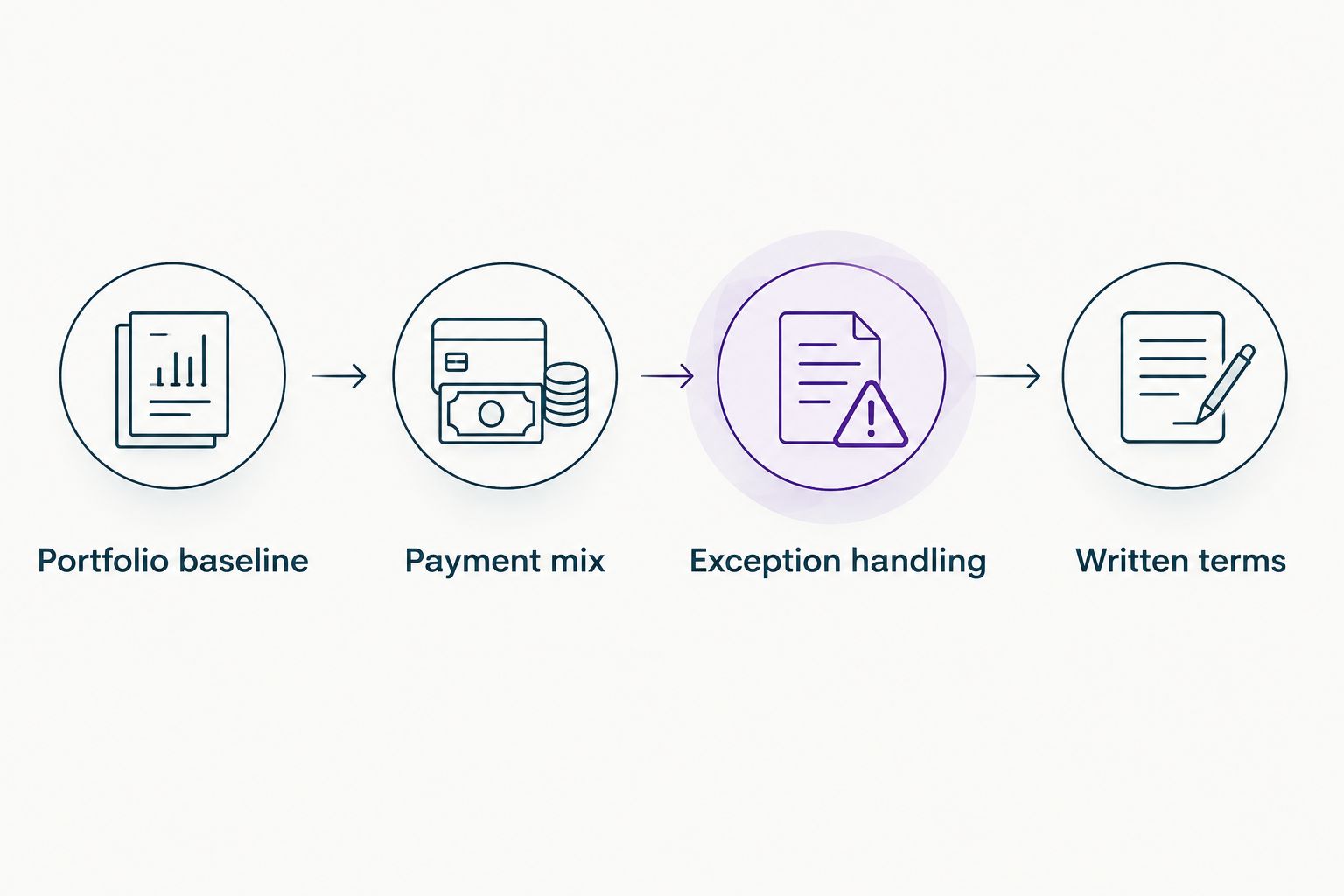
Build a worksheet with these four sections:
Portfolio baseline: Record occupied units, expected rent payments, and the comparison period. Use a 12-month period to capture recurring commitments.
Payment mix: Separate expected bank transfers from card payments. Record which party bears each applicable charge.
Exception handling: Check the written terms for unsuccessful payments, disputes, refunds, and optional services. Include only charges that apply.
Written terms: Save the plan details, payment terms, billing rules, and cancellation conditions used in your decision.
Keep landlord-paid expenses separate from tenant-paid charges. A charge does not disappear from the tenant experience because it sits outside your own bill.
Your worksheet should answer two different questions: what do you pay, and what does the tenant pay? Combining them into an unlabeled total hides who carries the expense.
Test three monthly scenarios
Prepare 3 monthly scenarios: your expected payment mix, an all-bank-payment month, and a month with more card payments. These are planning cases, not forecasts.
Apply each provider's current terms to all three. This exposes whether your preferred option depends on tenants choosing a particular payment method.
Keep unusual events separate from routine expenses. Do not present a hypothetical dispute or unsuccessful payment as something that happens every month.
Give the workflow a practical test
Set aside 30 minutes to review a demonstration or guided walkthrough. Ask to see a tenant balance, a submitted payment, an unsuccessful payment example, and the records you would use for reconciliation.
The point is not to reward the longest feature list. You need to understand what you will check when a tenant says the rent was paid but your records still show a balance.
How the ranking works
This 2026 ranking starts with the small-portfolio collection use case, then separates bank-first payments, card flexibility, and broader management needs. The criteria are landlord cost, tenant cost, payment fit, balance tracking, portfolio fit, and operational scope.
It is a shortlist order, not a claim that one provider has the lowest current price. Make the final cost ranking only after applying current written terms to the same worksheet.
Which rent collection setup should you choose?
Start with a dedicated rent collection platform if your main frustrations are collecting payments and tracking balances. Compare a bank-first workflow when your tenants prefer bank payments; include card functionality when that payment option matters.
Choose a broader suite only when you have named the additional jobs it must replace. For your 2026 decision, a clear match between the software and your work is more useful than a long feature checklist.
Default recommendation: shortlist a collection-focused platform, compare both sides' charges, and test the ledger before committing.
FAQ
What's the best way to compare rent collection software pricing?
Compare current written terms against the same portfolio, payment mix, and billing period. Separate landlord-paid expenses from tenant-paid charges, and review exception-related charges separately.
Is Payrent suitable for a small rental portfolio?
Payrent serves independent landlords and property managers with small rental portfolios. It supports bank transfers, credit card rent payments, and tenant balance tracking.
Is bank-transfer rent collection always the cheapest option?
A payment-method label does not establish which option has the lowest total cost. Apply each provider's current terms to your expected payment mix before ranking the alternatives.
Should I let tenants pay rent by credit card?
Offer card payments when that option fits your tenants and your collection process. First verify applicable charges, tenant disclosures, dispute handling, and relevant lease and legal requirements.
Do I need full property management software just to collect rent?
Rent collection alone does not require choosing a broader management suite. Evaluate a suite when you also have specific accounting, maintenance, or other management workflows to replace.
What should I check before switching rent payment platforms?
Check tenant balances, payment status definitions, records access, and the transition process. Give tenants clear instructions so the change does not create uncertainty about where or how to pay.
How often should I review my rent collection software costs?
Review the current terms before committing, renewing, or changing your payment setup. Recalculate the comparison when your portfolio or tenant payment mix changes.
One last thing
A successful payment and an accurate tenant balance are related, but they are not the same check. Before switching, reconcile your existing balances and decide how you will handle payments submitted during the transition.
Choose a clear cutover process before inviting tenants to the new platform. A pricing worksheet cannot prevent confusion about which system holds the correct balance.
Related guides
Written by
David Paxton
Dave is a seasoned real estate investor with over 12 years of experience in the industry. Specializing in single-family residential real estate, David's strategic approach combines market analysis, financial acumen, and a deep understanding of urban development trends to maximize investment returns.